


Music Theory
This is where I document some random music theory stuff.
Theory Notes and Articles
- Augmented chords.
- Microtonality.
- The mistakes regarding Piano Adventures (Level 2B, Lesson book).
- 36-EDO is underused.
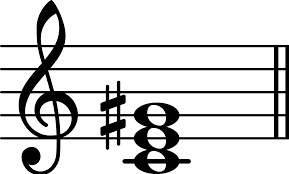
Augmented chords are like major chords, but the fifth degree is raised. Usually written with a +, but also notated as aug or (♯5). They have a dissonant sound,but mostly used in songs for tension moments and transitional chords. A detail is that augmented chords cannot be inverted. So, if you put a C augmented chord, but treat E as the root, you could label is as a C +/E chord, but it'd be an E augmented chord.
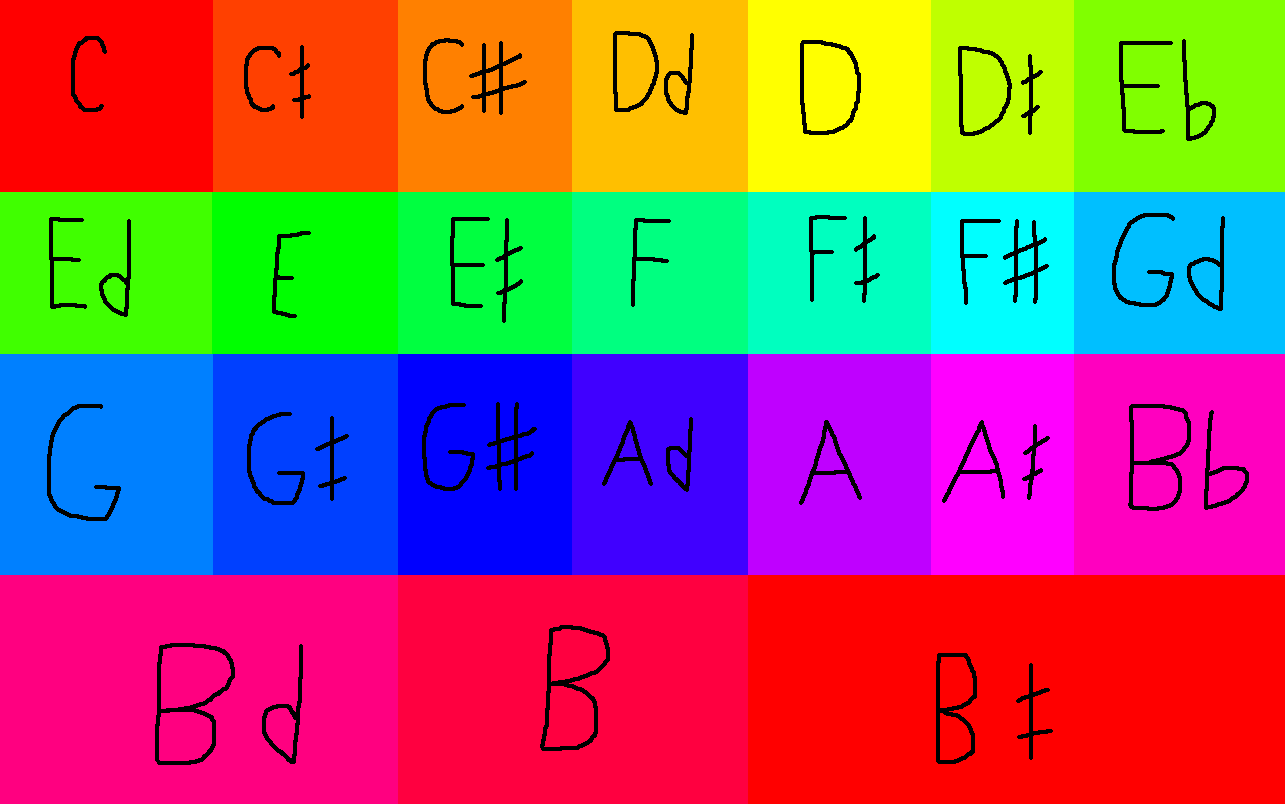
A semitone is the smallest interval we can do in western music; for example, C to C sharp. Our standard tuning system is 12 tone equal temperament, pretty much every music you hear uses this. However, there are intervals SMALLER than that, and these are microtonal intervals. There are three main tuning system for them; 24-TET, 31-TET and 22-TET. For this one, I'll focus more on 24-TET. You have the 12 tone system, and then you add microtones between every note (you can see my color chart on the image I've put). To notate this, you can use half flats and sharps, which are quarter tone accidentals. Classical composers like Wyschnegradsky did it often with two pianos. Now, on modern music, I'll cite at least two examples. King Gizzard and The Lizard Wizard made the album Flying Microtonal Banana, back in 2017, where they ue instruments they made on purpose for microtones. On Rattlesnake, for example, it uses an F sharp minor scale, but the second and sixth degrees have been half-sharpened. Probably the best instrument for microtones is the voice, ince it' not constricted to any tuning system. On Jacob Collier's arrangement of In The Bleak Midwinter (2016), he modulates at a certain part from E Major to G half sharp major. Now, we've been only talking about western cultures. In other places, like the middle east, microtonality can actually be very common.
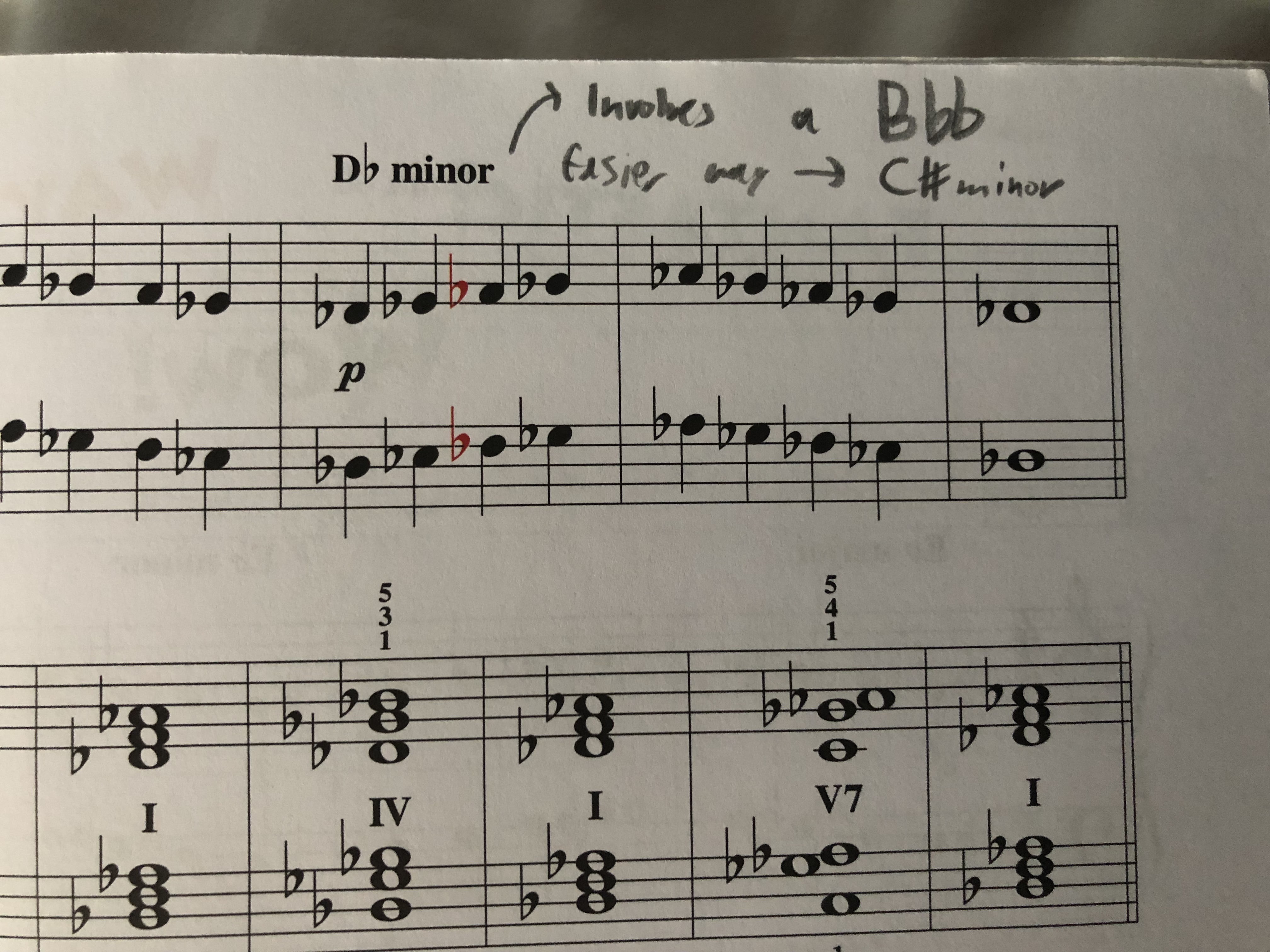
This is the book I currently use for piano lessons, and I was able to notice two mistakes on it. First, on the piece where pianissimo (pp) is introduced. The song itself is in 3/4 time, but the main beat on it is the eighth note, meaning that'd technically be 6/8 instead. But I actually understand why they did this, as compound meters only appear in the next book (level 3A), so this would be a bit forgivable. Now, the unforgivable mistake appears on the keys chhallenge, at the D-flat section. At first, there's Db major, as usual, but then it's followed by Db minor. Now, this is an actual thing, but it's a theoretical key. Its natural version is a mode of F-flat major, which along with Db minor, contains eight flats, with a B-double flat (Bbb), although here it's only shown to the fifth degree. Keep in mind that double accidentals only appear by level 4, so it's a bigger gap than the one with compound meters. So, to make this readable, you make them into, respectively: E major and C-sharp minor, both with four sharps. Aside from C# minor being an alternative, C# major also exists as a standard key (7 sharps), although it's less common.

When most people choose a temperament system other than 12-EDO, mostly they go with 19-EDO, 22-EDO, 24-EDO, 31-EDO, or even 53-EDO. The thing is, 36-EDO has some good septimal minor thirds (7/6) and septimal whole tones (8/7), so at first glance, it's a great choice for someone who wants to expand harmony up to the 7th harmonic. The biggest advantage is that 36-EDO includes 12-EDO, which is actually important. The 12-EDO intervals make five-limit music very simple by just tempering out everything else. Oftenly, you'll need those bad approximations to make your composition work. Other EDOs have more trouble with parts that return to simplicity for a bit. The two most similar systems (31-EDO and 41-EDO) have better thirds, but given that thirds already work well in 12-EDO, it's not that much of a problem. Another thing is that 36 has a lot of numbers that divide it, so playing scales can be much easier.
You can see that people really want to try out new and exotic things first (like when I started with 24-EDO), and within that, 36-EDO looks boring in comparison. Still, it offers a lot of new possibilities that might be very straightforward, but haven't been explored yet.
Fun fact: Alois Hába used this system in Six compositions for sixth-tone harmonium (Opus 37), and this sixth-tone harmonium was one of the many custom instruments he had. He also used to refer to this system as "the sixth tone system".